
- English
- Español
- Português
- русский
- Français
- 日本語
- Deutsch
- tiếng Việt
- Italiano
- Nederlands
- ภาษาไทย
- Polski
- 한국어
- Svenska
- magyar
- Malay
- বাংলা ভাষার
- Dansk
- Suomi
- हिन्दी
- Pilipino
- Türkçe
- Gaeilge
- العربية
- Indonesia
- Norsk
- تمل
- český
- ελληνικά
- український
- Javanese
- فارسی
- தமிழ்
- తెలుగు
- नेपाली
- Burmese
- български
- ລາວ
- Latine
- Қазақша
- Euskal
- Azərbaycan
- Slovenský jazyk
- Македонски
- Lietuvos
- Eesti Keel
- Română
- Slovenski
- मराठी
- Srpski језик

How Unpowered Roller Conveyor Lines Improve Material Handling Efficiency in Modern Warehouses?
In furniture manufacturing, panel processing and warehouse operations, material handling can easily become a bottleneck when operators need to move heavy or large workpieces between machines, inspection areas and packaging stations. Unpowered Roller Conveyor Lines provide a simple and practical way to improve material flow without requiring a motor on every conveyor section. With more than 20 years of experience in conveying equipment, FORTRAN Machinery develops conveyor solutions for flat panels, boards and other workpieces, helping manufacturers reduce unnecessary manual handling while keeping production areas flexible.
Contents
- Why Material Handling Matters in Modern Warehouses
- How Gravity Roller Conveyors Improve Material Flow
- FORTRAN's Approach to Conveyor Line Design
- Typical Applications in Furniture and Panel Processing
- Key Construction and Specification Details
- Unpowered vs. Powered Conveyor Solutions
- What to Consider Before Choosing a Conveyor Line
- Frequently Asked Questions
Why Material Handling Matters in Modern Warehouses
Warehouse efficiency is not only determined by storage capacity or production equipment. The time required to move materials from one workstation to another can also have a direct effect on overall productivity.
This is particularly noticeable in furniture factories and panel-processing plants. A single production order may involve edge banding, drilling, sanding, inspection, sorting and packaging. If operators have to repeatedly lift and carry panels between these processes, labor is spent on transportation instead of value-added work.
FORTRAN Machinery has been manufacturing conveying equipment since 2002, with its early business focused on conveying solutions for furniture production. Today, the company provides equipment for production conveying, order sorting and packaging, together with customized automation solutions based on the customer's factory layout.
In many of these applications, Unpowered Roller Conveyor Lines can provide a practical connection between individual production stations. Operators can push a panel across the rollers manually, while gravity can assist movement when the conveyor is installed with an appropriate incline.
How Gravity Roller Conveyors Improve Material Flow
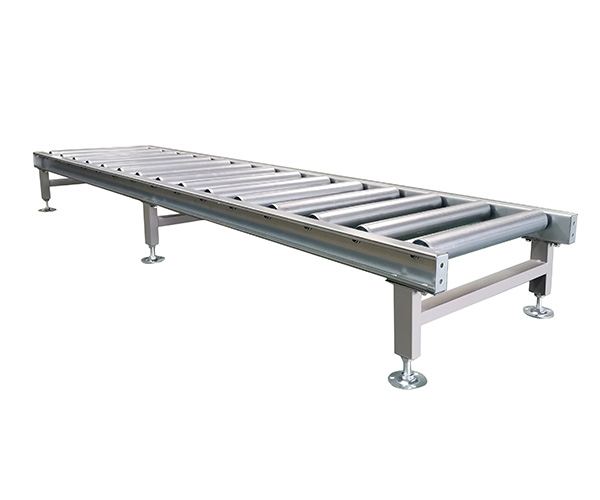
A gravity roller conveyor does not require a drive motor to move every workpiece. Instead, the operator pushes the material, or the conveyor can use a slight slope to allow suitable loads to move by gravity.
This simple operating principle is one of the main reasons gravity roller conveyors are widely used for boxes, cartons, panels and other relatively flat workpieces.
For flat furniture panels, the roller arrangement needs to provide sufficient support across the workpiece surface. When the panel is placed correctly, the rollers allow it to move forward with less friction than direct contact with the floor or worktable.
Another practical advantage is layout flexibility. Conveyor sections can be arranged around machines, inspection areas or temporary storage points without creating a complicated powered drive system for every section. This is useful when a factory frequently changes its production arrangement or handles products with different dimensions.
FORTRAN's Approach to Conveyor Line Design
FORTRAN Machinery is based in Foshan, Guangdong, and combines mechanical structure design, software development, equipment manufacturing and automation engineering. The company has served more than 1,900 customers globally and has supplied automation equipment to furniture manufacturers and other industrial users.
Rather than treating a conveyor as an isolated machine, FORTRAN looks at how the conveyor will connect with the customer's existing production process. The required conveyor length, working height, panel dimensions, loading direction and connection with upstream and downstream equipment can all affect the final design.
For example, a furniture manufacturer may need to move boards from an edge banding machine to a sorting or inspection area. In this situation, the conveyor needs to provide enough working space for operators while keeping the panel stable during manual transfer.
FORTRAN's experience with furniture automation also means that the conveyor can be considered as part of a larger automation project rather than simply a standalone transport table. The company has supplied automation solutions for customers including SCM, Holike, Nature, Oppein and SOGAL.
For more information about the product range, see the Unpowered Roller Conveyor Series.
Typical Applications in Furniture and Panel Processing
One of the strongest application areas for Unpowered Roller Conveyor Lines is furniture manufacturing, especially where large flat panels need to be transferred between processing operations.
| Application | Typical Material | How the Conveyor Helps |
|---|---|---|
| Edge banding | Furniture panels, MDF, particle board | Provides a convenient transfer surface between processing and inspection areas |
| Six-side drilling | Flat furniture boards | Supports manual positioning and transfer of panels |
| Sanding | Wood panels and processed boards | Helps operators move finished or semi-finished panels with less floor handling |
| Order sorting | Panels and packaged components | Creates a defined area for sorting different orders |
| Packaging preparation | Flat boards, cartons and components | Provides temporary accumulation and manual transfer space |
The same principle can also be applied in warehouses where cartons, packages or other suitable loads need to be transferred over a relatively short distance. The correct roller diameter, pitch and frame structure should be selected according to the actual load and workpiece dimensions.
Key Construction and Specification Details
The physical construction of the conveyor matters because a material handling system is exposed to repeated loading, pushing and movement throughout the working day.
FORTRAN's conveyor construction includes several details intended for industrial environments:
- Hot-galvanized main beam: The galvanized surface provides improved resistance to corrosion and is suitable for long-term industrial use.
- Hot-dip galvanized rollers: The roller tubes are treated for higher corrosion resistance and regular material handling applications.
- CNC-bent frame: CNC bending technology is used to improve consistency in the mechanical structure and frame processing.
- Adjustable working height: The active plate height can be adjusted to accommodate different installation conditions, including uneven factory floors.
- Optional end baffles: Baffles can be installed at the two ends of the conveyor to help prevent panels from moving outside the working area.
For a factory purchasing a conveyor system, these details are more important than simply looking at the conveyor's overall appearance. The equipment should match the actual material size, weight, working height and frequency of use.
Unpowered vs. Powered Conveyor Solutions
Unpowered Roller Conveyor Lines are not intended to replace powered conveyors in every application. The better choice depends on how the material needs to move and how much automation is required.
| Factor | Unpowered Roller Conveyor | Powered Conveyor |
|---|---|---|
| Drive system | Manual push or gravity | Motor-driven |
| Energy consumption | No conveyor drive power required | Requires electrical power |
| Layout flexibility | High for simple transfer areas | Suitable for continuous automated movement |
| Operator involvement | Usually required | Can be reduced through automation |
| Typical applications | Manual transfer, sorting, inspection, accumulation | Continuous production and automated transfer |
| System complexity | Relatively simple | Higher due to motors and control systems |
For a production line where panels already need to be manually inspected or positioned, an unpowered solution can be more practical than installing a motorized conveyor section. On the other hand, where products must move continuously at a controlled speed with minimal operator intervention, a powered conveyor may be more appropriate.
What to Consider Before Choosing a Conveyor Line
Before ordering a conveyor, manufacturers should provide the equipment supplier with several basic production details. This allows the supplier to recommend a structure that works with the actual factory process instead of relying on a standard size that may not fit the application.
- Workpiece dimensions: Provide the minimum and maximum length and width of the panels or packages.
- Maximum load: The conveyor structure and roller arrangement should be selected according to the heaviest workpiece.
- Working height: The conveyor height should match the connected machine and operator working position.
- Factory floor condition: If the floor is uneven, adjustable supports can help level the conveyor.
- Transfer direction: The supplier should understand where the material enters and exits the conveyor.
- Connection with existing machines: The conveyor may need to interface with edge banders, drilling machines, sanding equipment, sorting areas or packaging stations.
- Safety requirements: End baffles and other protective structures can be considered when there is a risk of workpieces moving outside the intended area.
Providing this information at the quotation stage can save time during installation and reduce the risk of modifications after delivery.
Why Choose FORTRAN for Material Handling Projects?
FORTRAN has developed its conveying business around the requirements of furniture and industrial production for more than 20 years. The company's development has included standardized technology, production procedures, quality testing and supply chain management, followed by a stronger focus on customized automation solutions.
Today, FORTRAN manufactures automatic loading and unloading equipment, transmission lines, powered belt conveyors, lifting tables and industrial rollers in addition to its gravity conveyor range.
The company also provides pre-sale engineering communication, technical consultation during the project and after-sales support. This is particularly useful for customers who are not simply purchasing a conveyor section but are planning a complete material handling line.
For overseas projects, FORTRAN has supplied customers in Vietnam, Australia, Russia, Spain, Venezuela and more than 20 other countries. Its experience across different production environments allows the engineering team to consider both the equipment itself and the customer's site conditions.
Frequently Asked Questions
What materials can an unpowered roller conveyor handle?
It is commonly used for relatively flat and rigid workpieces such as furniture panels, boards, cartons, boxes and packaged products. The actual load capacity should be confirmed according to the material dimensions, weight and roller configuration.
Does an unpowered roller conveyor require electricity?
A basic gravity roller conveyor does not require a motor or electrical drive to move materials. Operators can push suitable workpieces manually, or gravity can assist movement when the conveyor is installed with an appropriate slope.
Can the conveyor height be adjusted?
Yes. FORTRAN's conveyor design can include adjustable working height, which is useful when the equipment needs to be installed on a floor that is not perfectly level or connected with machines at different heights.
Can end baffles be added to the conveyor?
Yes. Optional baffles can be installed at both ends to help prevent workpieces from moving outside the intended conveying area. This can be useful when handling large flat panels manually.
Is this type of conveyor suitable for furniture factories?
Yes. Furniture manufacturing is one of the main application areas for FORTRAN's conveying equipment. The conveyor can be used around edge banding, six-side drilling, sanding, sorting and packaging processes to reduce unnecessary manual carrying.
Can FORTRAN design a customized conveyor system?
Yes. FORTRAN provides customized automation solutions based on the customer's production process and site conditions. Customers can provide panel dimensions, maximum load, required conveyor length, working height, machine layout and transfer direction so the engineering team can evaluate the appropriate solution.
Conclusion
Efficient material handling does not always require a highly complex automated system. For factories that need flexible transfer, inspection, sorting or temporary accumulation of panels and packages, a well-designed gravity conveyor can solve a practical production problem with a relatively simple mechanical structure.
With more than two decades of experience in furniture production conveying and industrial automation, FORTRAN can evaluate the conveyor together with the customer's complete production workflow. This approach helps manufacturers choose between manual, gravity and powered conveying according to the actual process, rather than adding automation where it is not necessary.