
- English
- Español
- Português
- русский
- Français
- 日本語
- Deutsch
- tiếng Việt
- Italiano
- Nederlands
- ภาษาไทย
- Polski
- 한국어
- Svenska
- magyar
- Malay
- বাংলা ভাষার
- Dansk
- Suomi
- हिन्दी
- Pilipino
- Türkçe
- Gaeilge
- العربية
- Indonesia
- Norsk
- تمل
- český
- ελληνικά
- український
- Javanese
- فارسی
- தமிழ்
- తెలుగు
- नेपाली
- Burmese
- български
- ລາວ
- Latine
- Қазақша
- Euskal
- Azərbaycan
- Slovenský jazyk
- Македонски
- Lietuvos
- Eesti Keel
- Română
- Slovenski
- मराठी
- Srpski језик

How Can a Pneumatic Ball-floating Table Improve Panel Handling Efficiency in Modern Furniture Manufacturing
Article Summary: In modern furniture and panel-processing operations, moving heavy boards without damaging their surfaces can be a major productivity challenge. A Pneumatic Ball-floating Table from Fortran uses air-assisted floating balls to reduce friction between the workpiece and table surface, making large panels easier to reposition while helping minimize scratches and handling effort. This article explains its working principle, specifications, benefits, applications, and selection considerations for manufacturers seeking a more efficient material-handling solution.
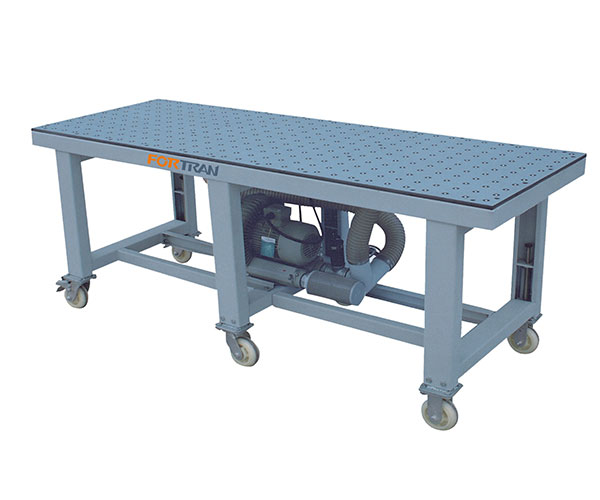
Table of Contents
- What Is a Pneumatic Ball-floating Table?
- How Does a Pneumatic Ball-floating Table Work?
- What Are the Key Benefits?
- What Are the Main Specifications?
- Where Is It Used?
- How Should You Select the Right Table?
- How Does It Compare With Conventional Handling Tables?
- Frequently Asked Questions
- Final Considerations
What Is a Pneumatic Ball-floating Table?
A Pneumatic Ball-floating Table is an air-assisted work platform designed to make the manual movement of panels and boards easier. Instead of requiring operators to drag a heavy workpiece directly across a fixed surface, the system uses pneumatic air pressure to gently lift floating balls within specially designed sleeves. This creates a low-friction contact surface between the table and the material.
According to the product information provided by Fortran, the FQ-QFT model is designed as a practical working platform for panel handling. Its structure incorporates evenly spaced holes, rubber sleeves, air inlets, and floating balls. When air is introduced, the balls rise slightly and support the workpiece, allowing operators to move panels with considerably less resistance.
This principle is particularly valuable in furniture manufacturing, where large wood panels, boards, and finished surfaces must frequently be repositioned during cutting, processing, assembly, or transfer.
How Does a Pneumatic Ball-floating Table Work?
The operating principle is relatively straightforward but highly practical. A pneumatic air source supplies air through the table's internal air inlet system. The airflow causes the balls installed inside their rubber sleeves to rise from the table surface.
Once the panel is placed on the floating balls, the direct friction between the panel and the working platform is significantly reduced. Operators can then push, pull, rotate, or reposition the material with less physical effort.
- Air supply: Compressed air is introduced into the pneumatic system.
- Ball lifting: Air pressure raises the floating balls through their sleeves.
- Low-friction support: The panel rests on multiple floating contact points.
- Panel movement: Operators can reposition the material more smoothly.
- Controlled handling: Reduced dragging helps lower the possibility of surface damage.
The result is a work surface that can make heavy panels feel substantially easier to handle without relying exclusively on mechanical conveying equipment.
What Are the Key Benefits?
The value of a pneumatic floating table goes beyond simply making panels easier to move. In a production environment, reducing handling resistance can influence labor efficiency, material protection, and overall workflow.
1. Reduced Manual Handling Effort
Large panels can be difficult to reposition because of their weight and surface friction. By creating an air-assisted floating effect, the table reduces the force required to move the workpiece. This can make repetitive panel positioning more manageable for operators.
2. Better Surface Protection
Finished boards and decorative panels can be vulnerable to scratches when dragged across conventional work surfaces. The floating-ball design provides multiple rolling contact points and is specifically intended to help prevent panel scratching.
3. Improved Material Flow
When operators can reposition boards faster and with less resistance, the handling stage can become more efficient. For production lines involving several processing stations, smoother material movement can contribute to better workflow continuity.
4. Strong Structural Design
The FQ-QFT table uses welded sheet-metal components to create a solid working structure. The published specification lists a 40 × 60 mm main beam, providing a structural foundation for industrial panel-handling applications.
5. Flexible Panel Movement
The product specification indicates a 360-degree transmission angle, making the concept suitable for operations where panels need to be repositioned in multiple directions rather than simply moved along a straight conveyor path.
What Are the Main Specifications?
Understanding the technical specifications is essential when evaluating a Pneumatic Ball-floating Table for a production facility. The following data is based on Fortran's published FQ-QFT model information.
| Specification | FQ-QFT Model |
|---|---|
| Model | FQ-QFT |
| External Dimension | L1800 × W900 × H930 mm |
| Main Beam | 40 × 60 mm |
| Loading Capacity | 100 kg/meter |
| Transmission Angle | 360 degrees |
| Surface Design | Pneumatic floating balls |
| Primary Function | Low-friction panel handling |
For buyers comparing equipment from a China manufacturer or supplier, these parameters provide a useful starting point. However, the actual table configuration should always be evaluated against the dimensions, weight, material characteristics, and workflow requirements of the intended production line.
Where Is It Used?
A Pneumatic Ball-floating Table is especially relevant to industries where large, flat workpieces need frequent repositioning. Furniture manufacturing is one of the most natural applications because panel processing often involves repeated manual or semi-automatic handling.
Potential applications include:
- Furniture panel processing and assembly
- Wood board handling
- CNC panel processing workflows
- Cabinet manufacturing
- Decorative board handling
- Panel inspection and positioning
- Material transfer between processing stations
- Intelligent furniture production lines
Fortran places the product within its Intelligent Factory Furniture Production Line Series Single Machine category, alongside equipment such as turnover machines, roller conveyors, loading and unloading systems, and other material-handling equipment.
This makes the table particularly interesting for manufacturers looking to improve individual handling stations or integrate multiple material-handling functions into a broader production system.
How Should You Select the Right Table?
Choosing the right pneumatic floating table should begin with the workpiece rather than the machine alone. Procurement teams should evaluate several factors before placing an order.
- Panel weight: Confirm that the expected workpiece load remains within the equipment's rated capacity.
- Panel dimensions: Compare the largest and smallest workpieces with the available table dimensions.
- Surface requirements: Consider whether the panels have finished, coated, laminated, or scratch-sensitive surfaces.
- Workflow direction: Determine whether operators need linear movement, rotation, or multidirectional positioning.
- Production volume: Higher-volume factories may benefit more from integrating floating tables into automated material-handling systems.
- Maintenance requirements: Select a structure that allows convenient inspection and maintenance of pneumatic components.
Buyers should also communicate their actual production conditions to the manufacturer. A professional Pneumatic Ball-floating Table supplier can use information such as panel dimensions, loading requirements, process layout, and desired material flow to determine whether a standard configuration or customized solution is more appropriate.
How Does It Compare With Conventional Handling Tables?
| Factor | Pneumatic Ball-floating Table | Conventional Fixed Table |
|---|---|---|
| Panel Movement | Low-friction movement assisted by floating balls | Usually requires more manual pushing or dragging |
| Surface Protection | Designed to reduce scratching during movement | Depends strongly on the table surface material |
| Operator Effort | Reduced when air flotation is active | Generally higher for heavy panels |
| Movement Direction | Suitable for multidirectional positioning | Usually dependent on the table design |
| Production Integration | Can complement automated handling systems | More commonly used as a basic work platform |
The key difference is not simply automation level. Instead, the pneumatic design changes the physical interaction between the workpiece and the table, allowing operators to manipulate panels with substantially less sliding resistance.
Frequently Asked Questions
1. What is the main purpose of a Pneumatic Ball-floating Table?
Its primary purpose is to facilitate the movement and positioning of panels by reducing friction between the workpiece and the table. The floating balls rise under air pressure and provide low-friction support.
2. What is the loading capacity of the Fortran FQ-QFT model?
The published specification for the FQ-QFT model states a loading capacity of 100 kg/meter. Buyers should confirm the suitability of the specification according to their actual workpiece size and weight.
3. Can the table help prevent panel scratches?
Yes. The pneumatic floating-ball surface is designed to reduce direct sliding contact and help prevent scratches when panels are repositioned.
4. Is the Pneumatic Ball-floating Table suitable for furniture factories?
Yes. Furniture panel processing is a key application area, particularly where large boards need to be repeatedly positioned, transferred, inspected, or connected with other production equipment.
5. Can a pneumatic floating table be customized?
Customization may be considered when the standard dimensions or configuration do not match a specific production line. Buyers should provide detailed requirements, including panel size, weight, workflow, table height, and installation conditions, when requesting a quotation.
Final Considerations
A Pneumatic Ball-floating Table offers a practical approach to one of the most common challenges in panel processing: moving heavy or delicate boards efficiently without unnecessary friction or surface damage. With its air-assisted floating-ball mechanism, solid welded structure, 100 kg/meter loading specification, and 360-degree transmission capability, the Fortran FQ-QFT provides a useful solution for furniture manufacturing and intelligent material-handling workflows.
For manufacturers evaluating a China Pneumatic Ball-floating Table manufacturer or supplier, the most important considerations are not only price, but also structural quality, application compatibility, customization capability, maintenance convenience, and integration with the existing production line. If you are planning to improve panel handling efficiency or need a customized material-handling solution, contact us to discuss your application requirements and receive professional product guidance and a suitable quotation from Fortran.