
- English
- Español
- Português
- русский
- Français
- 日本語
- Deutsch
- tiếng Việt
- Italiano
- Nederlands
- ภาษาไทย
- Polski
- 한국어
- Svenska
- magyar
- Malay
- বাংলা ভাষার
- Dansk
- Suomi
- हिन्दी
- Pilipino
- Türkçe
- Gaeilge
- العربية
- Indonesia
- Norsk
- تمل
- český
- ελληνικά
- український
- Javanese
- فارسی
- தமிழ்
- తెలుగు
- नेपाली
- Burmese
- български
- ລາວ
- Latine
- Қазақша
- Euskal
- Azərbaycan
- Slovenský jazyk
- Македонски
- Lietuvos
- Eesti Keel
- Română
- Slovenski
- मराठी
- Srpski језик

FORTRAN Belt‑Driven Panel Turner: Gentle 180‑Degree Flipping for Continuous Woodworking Production Lines
For modern panel furniture manufacturers, double‑sided processing represents a routine yet challenging production step. Panels frequently need to be flipped 180 degrees for back‑side sanding, coating, drilling, quality inspection or secondary edge treatment. Many factories still rely on manual labour or mechanical clamp‑style turners to rotate large boards. Manual flipping demands multiple workers, slows down line speed and brings safety risks, while clamping‑type turnover equipment often leaves indentations, scratches or edge damage on high‑value melamine, PET and veneered panels. To address these widespread manufacturing pain points, FORTRAN highlights its advanced belt‑driven panel turner, an inline automation unit built for damage‑free, high‑continuous panel flipping within automated wood‑processing workflows。
Unlike traditional clamping or sucker‑based turnover devices, FORTRAN belt‑driven panel turners adopt synchronized flexible belt assemblies to hold and rotate panels. Workpieces travel smoothly through the circular turnover frame, completing precise 180‑degree rotation while staying in horizontal conveying posture throughout the whole cycle. There are no hard mechanical jaws squeezing board edges, nor vacuum suction cups leaving spot marks on decorative surfaces. Soft, high‑wear‑resistant belts deliver even surface‑wide pressure, making this machine especially well‑suited for glossy, laminated, painted and easily‑marred cabinet panels, wooden doors and MDF boards. Surface‑defect reject rates drop significantly, protecting manufacturers from costly material losses.
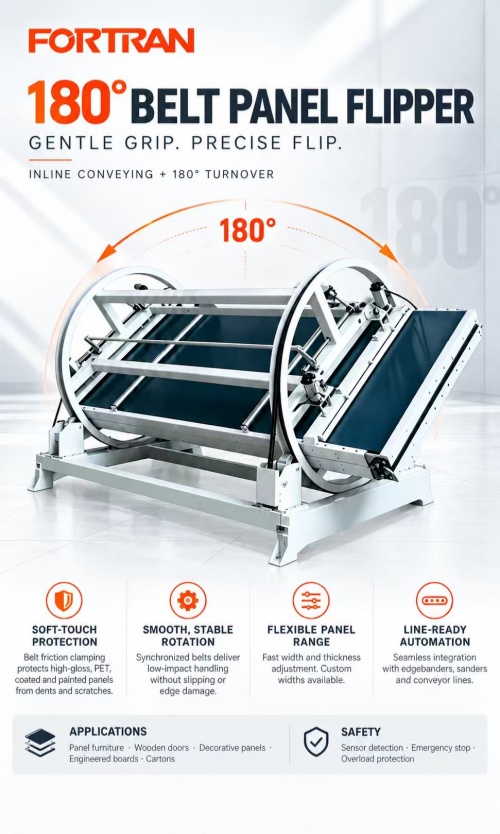
One core competitive advantage lies in its seamless inline integration capability. The machine maintains straight‑line material in‑feed and out‑feed without redirecting conveyor paths. It can be directly inserted between edge‑banding machines, wide‑belt sanders, panel cleaning stations and roller conveying lines. Factories do not need large‑scale reconstruction for existing workshops; simple docking allows it to fit both newly‑built automated plants and production‑line retrofitting projects. Photocell sensors detect incoming panel dimensions automatically. Cooperating with PLC control and HMI touchscreen interface, the turner adjusts operating speed to match upstream and downstream line rhythm, supporting non‑stop continuous flow instead of intermittent batch processing.
Flexible adaptability further expands its application scope. FORTRAN’s belt‑driven panel turner handles a broad range of panel sizes, thicknesses and weights, covering thin decorative sheets up to heavy‑duty particle‑board and plywood. Operators can modify running parameters via the control panel according to real‑time workpiece specifications. Whether customers run high‑volume mass‑produced cabinet orders or mixed‑batch custom furniture jobs, the equipment maintains stable flipping performance. Multiple built‑in safety mechanisms including safety light curtains, overload protection and emergency‑stop functions stop operation instantly in case of jams, protecting both workshop operators and mechanical components, fully complying with international industrial safety norms.
From an operational‑cost perspective, this automated belt‑style turner brings tangible economic returns for furniture factories. It eliminates heavy‑duty manual flipping work that historically required two or more workers. Staff can shift focus toward quality monitoring rather than strenuous material handling, cutting labour expenses and lowering the risk of workplace lifting‑related injuries. Continuous inline flipping removes waiting gaps between processes, lifting overall line throughput. Many FORTRAN clients report noticeable improvement in daily output after deploying this unit. Its heavy‑duty welded steel frame structure and high‑quality transmission parts enable long‑hour multi‑shift workshop operation, while belt components are designed for easy replacement to keep routine maintenance work simple and time‑efficient.
Before delivery, every belt‑driven panel turner goes through rigorous factory acceptance testing. Engineers execute continuous cyclic turnover tests with different board types, inspect belt tension consistency, sensor response accuracy and full‑load running stability. All electrical and drive components are strictly checked. For overseas shipments, machines are packed with export‑grade moisture‑proof packaging, together with multilingual operation manuals, circuit diagrams and spare‑part kits to facilitate on‑site installation and commissioning for global clients.
FORTRAN supplies complete global after‑sales support for this equipment. Our technical team provides 24‑hour remote online guidance covering installation, parameter tuning and daily troubleshooting. On‑site engineer training and service can be arranged upon request for international buyers.
As panel‑furniture production keeps pursuing higher automation and better surface‑quality control, the belt‑driven panel turner acts as a vital intermediate station inside modern processing loops. It solves long‑standing conflicts among flipping efficiency, surface protection and line compatibility. Moving forward, FORTRAN will keep refining this turnover‑equipment series. We aim to deliver practical, durable automation hardware for furniture manufacturers across Europe, Latin America and Southeast Asia, supporting customers to achieve safer, lower‑waste and higher‑yield panel‑processing production.